
To read the full report, please download the PDF above.
Middle East Daily
EDWARD BELL
Head of Research
DIFC Branch – Dubai
T: +971 (4)387 5033
E: edward.bell@ae.mufg.jp
SOOJIN KIM
Research Analyst
DIFC Branch – Dubai
T: +971 (4)387 5031
E: soojin.kim@ae.mufg.jp
MUFG Bank, Ltd. and MUFG Securities plc
A member of MUFG, a global financial group
Middle East Daily
COMMODITIES / ENERGY
Oil show tentative moves, balancing expectations of a surplus with geopolitical risks. Oil prices edged higher overnight with Brent futures up 0.8% at USD 93.14/b and WTI adding 0.3% to USD 86.01/b. Both markets are tracking the improving conditions in oil market balances though disorderly sell-offs are being tempered by the apparent increase in regional geopolitical risk in the Middle East. Time spreads are proving more stubborn with the Brent 1-2 month spread moving back up to around USD 2.8/b. The API reported a build in commercial crude inventories in the US last week, rising by 5.3m bbl along with a similar sized increase in gasoline stockpiles while distillate inventories rose by 351k bbl. Japan’s Prime Minister Sanae Takaichi has proposed setting up an Asia-focused agency to oversee regional oil reserves to improve coordination and emergency releases. The organisation would be modelled on the IEA which contains OECD countries as members and which coordinates strategic petroleum reserves releases during times of energy crisis. Prime Minister Takaichi also indicated that the plan could help to improve the resilience of Gulf energy exporters by ensuring they had ready storage available overseas.
Gold consolidates after hawkish Fed speakers. Gold prices sold off 0.2% overnight and are continuing to move lower in early trade today, testing levels at USD 3,790/troy oz, its lowest level since Q3 2025. St Louis Fed president Alberto Musalem said he thought the US economy needed “several” rate hikes while John Williams from the New York Fed said “inflation is stubbornly high.” The growing hike expectations are weighing on the outlook for gold with few positive signals likely to emerge in the weeks leading up to the end of the year.
MIDDLE EAST - CREDIT TRADING
End of day comment – 17 November 2026. The weakness continued today with a sizeable spread widening. The morning had spreads about 5bp wider on some cash selling coupled with UST strength. Flows became a touch more balanced around midday but turned decisively bearish again into the close as US stocks took a leg lower. IG sovgn curves are about +10bp. QATAR 36s got hit into the close going out -0.5pt/+12bp. There was again some urgency to get out of higher beta sovgn as well, MOROC was offered down across the curve with 33s again the weakest in spread terms closing -0.5pt/+15bp, OMAN followed closing +10/15bp depending on the bond. Quasi sovgn bonds broadly mirrored the move in the respective sovgn curves. ADCBUH saw some trades in the fins space after pricing its PNC 5.5y AT1 at 7% (700mm). On the back of it ADCBUH 8 perps was active closing -0.375pt. Also seen sellers on the back of it in FABUH T2s where 35s closed -0.375pt. Risk looks very soft heading in to London close. The market still feels like dealers have bonds to go trying to find an exit. The path of least resistance remains wider. (Source: Dominik Roth, Credit Trader)
MIDDLE EAST - MACRO / MARKETS
Regional attacks increase in frequency. Geopolitical risks have increased in the Middle East in recent days with Iran claiming additional attacks against Bahrain earlier today along with an attempted attack against a military base in Kuwait. The US also carried out strikes against missile launch sites the Iranian Qeshm Island that overlook the Strait of Hormuz. The escalation of attacks follows an increased US military presence in the region with the arrival of the USS Theodore Roosevelt earlier this week.
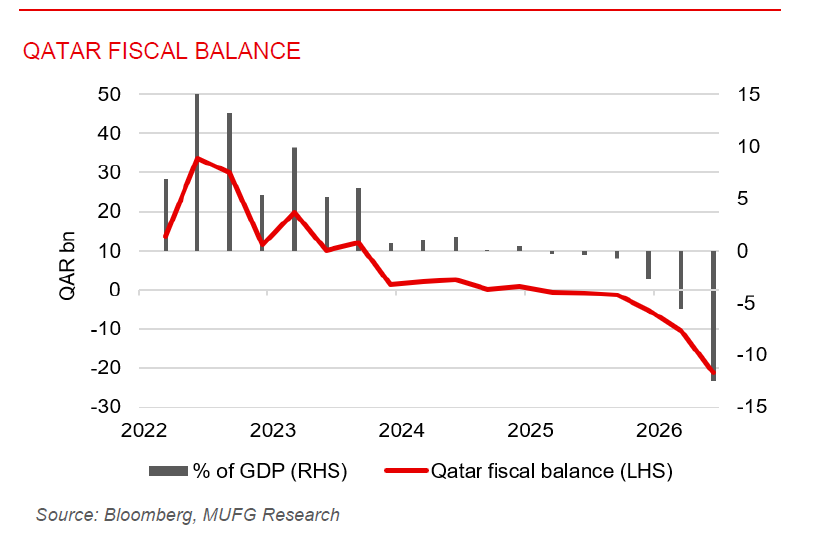
IMF expects strong recovery in Qatar’s economy. The IMF concluded a staff visit to Qatar noting that the country’s strong fiscal and external buffers have helped Qatar to endure the regional conflict. The fund expects real GDP to contract by 14.5% in 2026 compared with growth of 1.8% in 2025, largely down to the decline in natural gas production and LNG exports. The IMF also cited resilient performance of the non-oil sector, particularly in the travel and hospitality sector. Bearing in mind that regional geopolitical risks are weighted to the downside, the IMF nevertheless expects Qatar to return to a double-digit current account surplus and a surplus in the fiscal account. Qatar’s fiscal balance moved to a deficit of QAR 21bn in Q2 2026 or roughly 12.5% of GDP.
Turkish home sales extend their decline amid subdued consumer conditions. Home sales in Turkey fell 23% yy/y in October, slowing sharply from a drop of 9% in September. There were strong declines in both new (-13%) and existing (-28.5%) home sales while commercial transactions were also lower by 13% from a year earlier. Property price growth is cooling in Turkey with house prices up 21% y/y in October, down from 29% at the end of last year and an average of more than 43% y/y in 2024. High inflation and rates are cooling consumer activity in the Turkish economy with core retail sales growing by 0.8% in real terms in the first nine months of the year compared with 1.7% in the same period last year.