
To read the full report, please download the PDF above.
Middle East Daily
EDWARD BELL
Head of Research
DIFC Branch – Dubai
T: +971 (4)387 5033
E: edward.bell@ae.mufg.jp
SOOJIN KIM
Research Analyst
DIFC Branch – Dubai
T: +971 (4)387 5031
E: soojin.kim@ae.mufg.jp
MUFG Bank, Ltd. and MUFG Securities plc
A member of MUFG, a global financial group
Middle East Daily
COMMODITIES / ENERGY
Oil trades flat overnight with Trump pushing Iran plans into 2027. Oil prices are pushing higher after closing flat overnight with Brent edging closer to USD 93/b and WTI closing in on USD 84/b. US President Donald Trump said that he was not “rushing into any decision on Iran” and that he would push any planned offensive into 2027, according to comments he gave to media. The US president also agreed with his Chinese and Russian counterparts to increase the “supply of refined petroleum products for the benefit of all nations” though there were few specifics on what that pledge would mean in practice and which countries would deliver on the increased supply. With little move on the front months, the forward curves has flattened slightly with the 1-2 month Brent spread easing back to a backwardation of USD 2.60/b from closer to USD 2.90/b overnight. European natural gas prices are up in early trade today at EUR 85.76/MWh after touching nearly as low as EUR 80/MWh overnight.
Gold extends slide as markets firm up hike expectations. Gold continues to move sharply lower with spot prices down 2.7% overnight and nearly another 3% in early trade today to USD 3,522/troy oz. Austan Goolsbee from the Chicago Fed was the latest Fed speaker to give hawkish views, saying that “everything’s always on the table” in the central bank’s fight against inflation. Markets have fully priced in a December hike from the Fed though have pared back on some of the expected moves for 2027.
MIDDLE EAST - CREDIT TRADING
End of day comment – 19 November 2026. Mixed performances, sentiment remains weak. It felt a bit like yesterday where until midday the market tried to stabilise but fell back in the afternoon once equities/ risk started to sell off again. There is now though a greater distinction between credits. IG outperformed today, especially the short end/ belly of the curve seem to have found a yield bid closing -2/-4bp with prices up to +0.125pt in the likes of ADGB and QATAR. Against this higher betas remain heavy in flow and positioning. Take MOROC 33s which continues to sell off closing -0.25pt/+3bp and now is +30bp WoW. Quasi sovgn remain quiet, ADNOUH 47s was active closing -0.125pt/+1bp. Besides ENEDEV remains heavy without finding clearing levels as sellers don't seem ready to hit lower bids. Fins remain active on a mix of risk off flows and new issue trading. Today FABUH announced a T2 10.5NC5.5 which prices at T+190bp in 500mm issue size. The order book ex JLM is reported to be 625mm (!!) and the pricing doesn't really offer much concession to the outstanding 36s (NC5 T+180bp mid). That doesn't mean it will trade bad, but optically tight new supply increases the likelihood of a new deal gone bad. (Source: Dominik Roth, Credit Trader)
MIDDLE EAST - MACRO / MARKETS
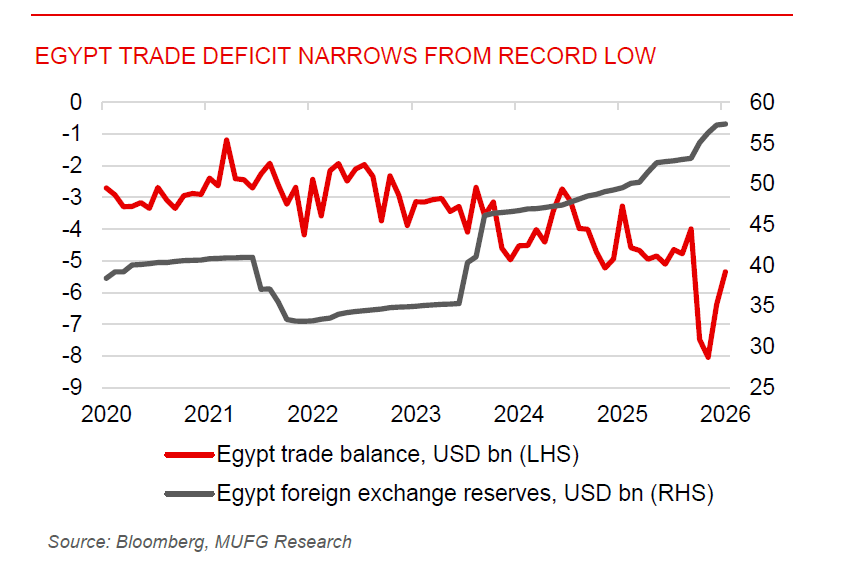
Egypt trade deficit narrows in October though still substantially wider than year ago levels. Egypt reported a narrower trade deficit of USD 5.3bn in September, down from USD 6.4bn a month earlier and a record high level of USD 8bn recorded in July this year. Exports expanded by 7% y/y to USD 5.3bn while imports were higher by nearly 30% to USD 11bn. While external price inputs – primarily energy costs – have increased this year, Egypt has maintained a flexible exchange rate to allow the currency to absorb the impact of a higher import bill. Even as import costs have moved higher, Egypt has been able to maintain record levels of foreign exchange reserves, estimated at USD 57.5bn as of October, or roughly six months of import coverage.
Jordan inflation accelerates in October. Inflation in Jordan accelerated to 2.9% y/y as of October, up from 2.7% a month earlier. The October print was the fastest so far this year and was the biggest uptick in inflation since 2023. Higher energy prices have been a primary contributor to Jordan’s inflation dynamic this year with transport costs, including fuel, up 7% y/y as of September 2026 and at an average of 4.1% this year compared with 0.3% on average in 2025.