
To read the full report, please download the PDF above.
Middle East Daily
SOOJIN KIM
Research Analyst
DIFC Branch – Dubai
T: +44(4)387 5031
E: soojin.kim@ae.mufg.jp
MUFG Bank, Ltd. and MUFG Securities plc
A member of MUFG, a global financial group
Middle East Daily
COMMODITIES / ENERGY
Oil heads for strong weekly gain as US intensifies pressure on Iran. Oil headed with Brent trading near USD94/b and WTI below USD87/b, as the US prepared sweeping measures aimed at further isolating Iran’s economy. The US is expected to detail the package next week, potentially targeting not only Iran but also countries and institutions that continue doing business with Iran, raising particular uncertainty around China, the largest buyer of Iranian crude. The measures come alongside the US naval blockade of Iranian ports, which Iran’s central bank governor said has virtually halted the country’s oil exports. Tensions over the Strait of Hormuz also remain elevated, with the US and Iran continuing to dispute control of the waterway and further vessel attacks reported this week. Supply pressures are being compounded by Ukrainian strikes on Russian refineries and ports, contributing to severe tightness in global diesel markets and record refining margins.
Gold heads for third weekly gain on debt concerns. Gold was on track for a third consecutive weekly gain, trading around USD4,530/oz, supported by concerns over rising US government debt and borrowing costs. The US Treasury’s unexpected expansion of long-dated debt buybacks initially pushed Treasury yields and the dollar lower, boosting gold, while Treasury Secretary Scott Bessent signalled that further buybacks and a new fiscal initiative could follow. Gold has now gained around 11% in August, also benefiting from renewed safe-haven demand and dip-buying after its earlier war-driven selloff. However, the rebound in oil prices poses a headwind by keeping US inflation risks elevated and preserving the possibility of further Fed rate hikes. Going forward, US Treasury yields and fiscal policy, the Fed’s rate outlook, and energy-driven inflation stemming from the US-Iran conflict will remain the key drivers.
MIDDLE EAST - CREDIT TRADING
End of day comment – 20 August 2026. We have said a number of times this month that inertia is low but today it felt a bit higher (or maybe EM is just slow). Even as rates gave back the Bessent bounce from yesterday the push for the market to add risk (or at least bid up bonds) continued leaving cash prices indicated higher than unchanged spreads would imply. While the intent to hold prices faded into the afternoon, we think it shows two things: 1) the market, still, is more scared of the rally than the sell off and 2) our spreads can lag and, if rates retrace sell offs quickly, our cash prices may not reflect those short-term moves. After a slew of bonds available to buy at the short end yesterday the short end of the KSA curve recovered 0.05-0.10c and 5bps or so which fed into ARAMCO and PIFKSA as well. There was local buying of mid curve PIFKSA pushing that part of the curve 4-5bps tighter independent of KSA or ARAMCO curves. Sukuk AT1s continue to be well bid regardless of the macro or rates back drop. (Source: Matthew Dunker, Credit Trader)
MIDDLE EAST - MACRO / MARKETS
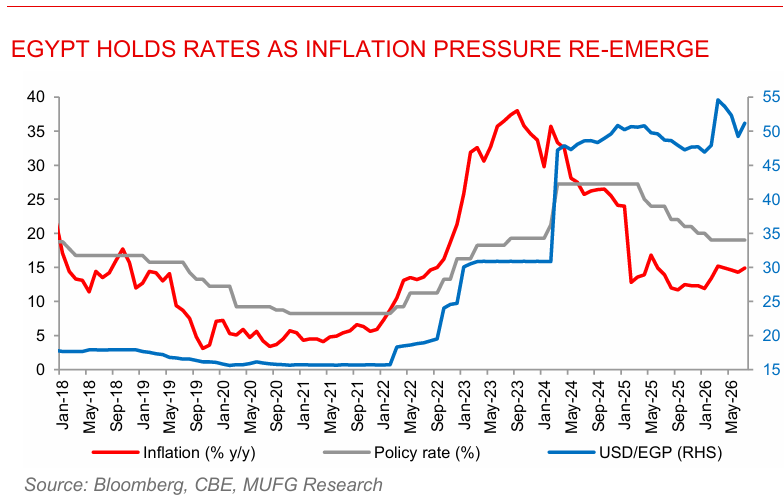
Egypt holds rates as inflation pressure re-emerge. The Central Bank of Egypt (CBE) kept policy rates unchanged for a fourth consecutive meeting on August 20, holding the overnight deposit and lending rates at 19% and 20%, respectively, as renewed inflation pressures outweighed the case for further easing. Inflation accelerated to 14.9% y/y in July from 14.3% y/y in June, amid administered-price increases including higher electricity tariffs. The CBE has consequently raised its 2026 average inflation forecast to 16–17%, although subdued monthly inflation suggests the recent pickup partly reflects base effects and one-off price adjustments rather than a broad acceleration in underlying pressures. Meanwhile, Egypt’s external position continues to strengthen, supported by record reserves of USD56.3bn, strong remittance inflows and a firmer pound, giving policymakers room to maintain relatively high real interest rates without further tightening. Looking ahead, the timing of renewed monetary easing will depend primarily on inflation resuming its downward trend, alongside continued currency stability and reserve accumulation, with rate cuts increasingly likely to be delayed until late 2026 or early 2027.
Morocco slips into deflation as food and fuel prices fall. Morocco’s inflation rate fell to -0.6% y/y in July, reversing June’s 0.3% increase, as a 3.7% decline in food prices more than offset a 1.9% rise in non-food costs. Consumer prices also dropped 1.0% m/m, led by cheaper vegetables, fish, fruit and meat, alongside a 4.9% fall in fuel prices as earlier energy-cost pressures unwound. Core inflation also edged into negative territory, indicating that disinflation has broadened beyond volatile food and energy components. Morocco consequently stands out from much of the region, where inflation remains positive or elevated, supported by favourable domestic food supply and relatively limited exposure to Gulf-related energy and shipping disruptions. The benign inflation backdrop gives Bank Al-Maghrib, which has kept its policy rate at 2.25%, significant flexibility to maintain an accommodative stance. The outlook for food and energy prices will remain key determinants of future monetary policy decisions.