
To read the full report, please download the PDF above.
Middle East Daily
SOOJIN KIM
Research Analyst
DIFC Branch – Dubai
T: +44(4)387 5031
E: soojin.kim@ae.mufg.jp
MUFG Bank, Ltd. and MUFG Securities plc
A member of MUFG, a global financial group
Middle East Daily
COMMODITIES / ENERGY
Oil extends decline as diplomacy and Hormuz flows ease supply fears. Oil fell for a fourth consecutive session, with Brent dropping below USD 102/b and WTI near USD 98/b as increased flows through the Strait of Hormuz and renewed diplomatic efforts reduced the geopolitical risk premium. President Trump indicated he may meet Iranian President Masoud Pezeshkian during the UN General Assembly, alongside planned talks with Chinese and Gulf leaders. Meanwhile, US Central Command said crude and LNG flows through Hormuz have reached a six-month high over the past two weeks, with key transit lanes clear of mines. Supply risks nevertheless remain elevated, with Saudi Arabia facing renewed Houthi threats and its damaged East-West pipeline yet to fully recover. Improving Hormuz traffic and prospects for diplomacy are weighing on prices, but Saudi export constraints and continued security risks around the Red Sea should keep the market vulnerable to renewed supply disruptions.
Gold edges lower as Fed tightening outlook weighs. Gold slipped below USD 4,360/oz, falling as much as 0.5% as investors assessed persistent inflation pressures and the outlook for further Fed tightening following last week’s 25bp rate hike. Minneapolis Fed President Neel Kashkari said inflation remains too high and has broadened beyond the energy shock caused by the Iran war, reinforcing expectations that monetary policy may need to remain restrictive. Gold remains caught between geopolitical and safe-haven support on one side and restrictive US monetary policy on the other, with the outlook for inflation and the pace of additional Fed hikes likely to remain the key drivers.
MIDDLE EAST - CREDIT TRADING
End of day comment – 18 September 2026. A typical Friday in terms of market activity. In terms of price action rather not though. The morning was very strong again, the bid in long bonds stepped up from the start and the short end/belly was initially immune to further flattening of the UST curve. That changed in the last 2 hours of trading as global markets got gripped by risk off. Credit indices turned wider and global rates markets continued to sell off. Dealers and ETFs turned sellers in GCC bonds, but there isn't a great deal of bid side liquidity. With cash anywhere from unch to -0.375pt the market still goes out 2/4bp tighter, but we have seen this many times before that such moves correct themselves at the beginning of the week when they look counterintuitive. In primary markets SIB announced to issue either 3y or 5y Sukuks, but with the continuous flattening of rates markets that yield difference between 3y and 5y might not look much different. (Source: Dominik Roth, Credit Trader)
MIDDLE EAST - MACRO / MARKETS
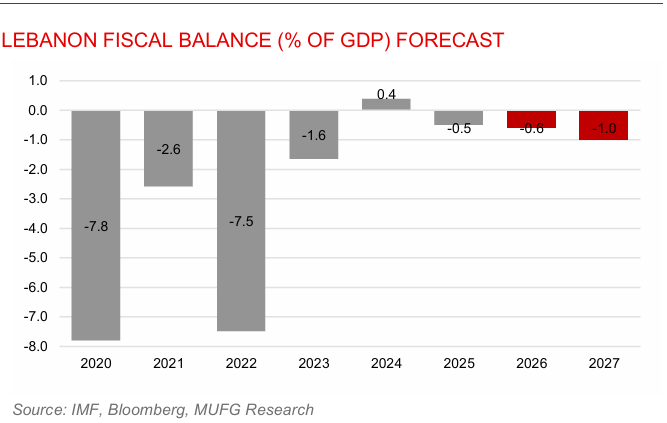
IMF welcomes Lebanon’s banking reforms but calls for further fiscal action. The IMF welcomed Lebanon’s progress on banking-sector restructuring while warning that regional instability continue to weigh heavily on the economy. Following a September 15–18 mission, the Fund said economic activity is expected to contract significantly in 2026, inflation remains in double digits, and the current account deficit has widened amid higher energy costs. The IMF welcomed amendments to the Bank Resolution Law, but stressed that the Financial Stabilisation and Deposits Recovery Law still need to meet international standards, including ensuring shareholders and junior creditors absorb losses before depositors. Fiscal policy has remained tight given financing constraints, while the draft 2027 budget targets a balanced position. However, the IMF urged implementation of the delayed VAT increase to 12% and cautioned against unfunded wage and pension increases. Completing banking reforms and adopting a credible medium-term fiscal framework remain critical steps toward restoring debt sustainability and securing a potential IMF-supported programme.
Qatar launches Doha Investment to manage QIA’s domestic portfolio. Qatar is establishing Doha Investment, a dedicated platform to manage the domestic portfolio of the USD 580bn Qatar Investment Authority (QIA) and accelerate private-sector-led development. Wholly owned by QIA but operating with its own board, the platform will oversee major domestic holdings, while supporting emerging businesses, deepening capital markets and attracting international investment. The restructuring should also allow QIA to sharpen its focus on its extensive global portfolio. Qatar plans to award around USD 38.5bn of infrastructure projects over the next five years, including PPPs, alongside a real estate and hospitality pipeline expected to attract USD 22.5bn in private capital. The initiative comes despite significant fiscal and economic pressures following damage to Ras Laffan, which has impaired around 17% of Qatar’s LNG export capacity. Doha Investment signals that Qatar intends to maintain its long-term diversification agenda despite the war shock, while relying more heavily on private and international capital to support domestic investment.