
To read the full report, please download the PDF above.
Middle East Daily
EDWARD BELL
Head of Research
DIFC Branch – Dubai
T: +971 (4)387 5033
E: edward.bell@ae.mufg.jp
SOOJIN KIM
Research Analyst
DIFC Branch – Dubai
T: +971 (4)387 5031
E: soojin.kim@ae.mufg.jp
MUFG Bank, Ltd. and MUFG Securities plc
A member of MUFG, a global financial group
Middle East Daily
COMMODITIES / ENERGY
Oil balances surplus forecasts with expectation of renewed conflict. Oil prices have been holding steady in the last few sessions, oscillating between tentative moves lower on growing market consensus of a sizeable build in oil market balances in 2027 and pushes higher on anxiety that regional geopolitics will deteriorate. Brent futures are trading around a USD 92.50/b level after losing ground by 3.4% last week, the third weekly loss in a row. WTI futures are trading in a similar pattern with spot futures flat in early trade today at USD 83.45/b after a 5.2% drop last week. Press reports suggest that US President Trump would wait until 2027 before resuming attacks against Iran while diplomatic outreach between Iran and the US continues. Iranian media also claims that two oil tankers had hit mines in the Strait of Hormuz overnight while the UKMTO confirmed an attack on a tanker on 22 November. Beyond the Gulf region, production in Libya has dropped by 350k b/d thanks to disruptions at the Sharara oil pipeline. Natural gas prices in Europe have jumped on the open today, up almost 6% at EUR 93.37/MWh following a drop in European weather forecasts.
Gold partially unwinds last week’s heavy selling. Gold prices are testing higher after heavy selling last week. Spot prices are trading at USD 3,607/troy oz after a near 9% loss last week. Equity futures in the US have turned positive in early trade today which may also provide some short-term supply for gold.
MIDDLE EAST - CREDIT TRADING
End of day comment – 20 November 2026. GCC markets saw a substantial spread widening today as global markets are firmly risk off. To be sure it was another quiet Friday in terms of activity. But selling flows dominated and dealers were reluctant to bids behind bid requests (if at all). Whilst news around Iran/Yemen neither got much worse nor better, there is in GCC markets also an element of reducing risk into the weekend on a just in case basis. Todays move can be described as: nothing is higher in cash price, despite the overnight UST rally and the 10bp rally today. At best short end/belly bonds in the IG space are unch with spreads anywhere from +12/+15bp. Then long end IG bonds and higher beta sovgn bonds were lower in cash, ADGB 54s going out -0.375pt/+15bp, MOROC remained for sale with 33s last -0.375pt/+20bp. Whilst corporate bonds were untraded, we did see some activity in financials around the latest supply and it wasn't pretty. New FABUH T2 had sellers from the start closing 99.125/99.50 (-0.625pt/+35bp). On the back of it, the market was selling outstanding T2 and AT1 in UAE names. No places to hide. (Source: Dominik Roth, Credit Trader)
MIDDLE EAST - MACRO / MARKETS
Japan and Saudi Arabia reach agreement on strategic oil storage. Japan will buy up to 8m bbl of crude oil from Saudi Arabia to refill its petroleum reserve following an agreement between the two countries. Saudi Arabia will also have access to 16m bbl of storage capacity in Japan, augmenting its preexisting 8m bbl of storage capacity. Saudi Arabia was the largest source of crude oil imports for Japan in 2025, representing 42% of the total, followed closed by the UAE at 41% with overall Middle East origin imports representing 93% of Japan’s total oil imports. Securing large and long-lasting oil supply relationships helps to ensure security of available supplies for Japan as a consumer but also provides Saudi Arabia with a reliable export destination. Further expansion of existing storage facilities or widening the number of countries that Saudi Arabia or other Middle East exporters have access to is likely following the disruptions to supply caused by the conflict this year.
Saudi Arabia to introduce corporate top-up tax in 2027. Saudi Arabia will implement a 15% top-up tax on multinational companies operating in the kingdom who have annual revenues of at least EUR 750m. The top-up tax brings Saudi Arabia inline with a wider OECD brokered deal on global taxation to allow countries to collect taxes if a company’s effective tax rate falls below a 15% threshold. The new tax will exclude companies that have Saudi-only operations.
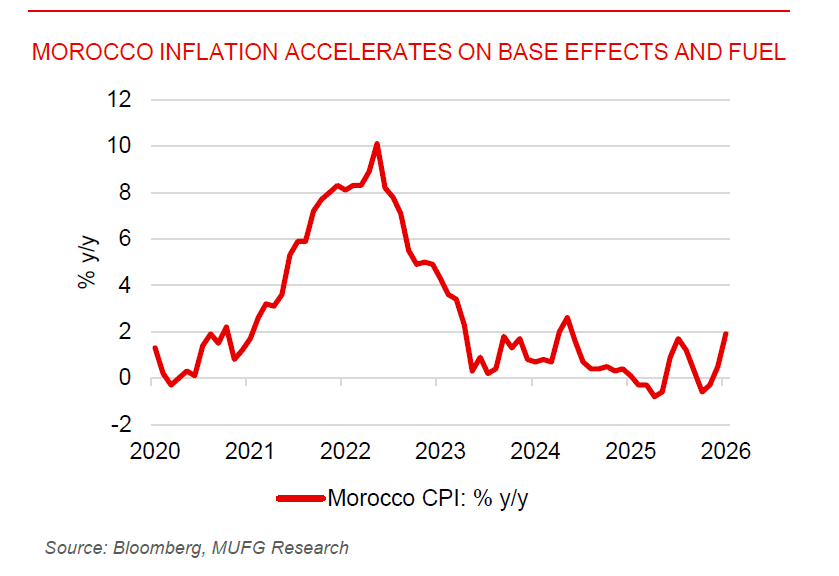
Higher fuel prices and base effects lifts Morocco inflation in October. Inflation in Morocco accelerated sharply in October to nearly 2% y/y, up from just 0.5% a month earlier. Base effects, with near 0 inflation in the second half of last year will likely mean that Morocco will record some of its fastest pace of inflation in the last few years over the next several prints. Like other economies across MENA, transport prices have been running ahead of the headline index with transport costs up nearly 12% y/y in October and likely to accelerate in coming months.