
To read the full report, please download the PDF above.
Middle East Daily
EDWARD BELL
Head of Research
DIFC Branch – Dubai
T: +971 (4)387 5033
E: edward.bell@ae.mufg.jp
SOOJIN KIM
Research Analyst
DIFC Branch – Dubai
T: +971 (4)387 5031
E: soojin.kim@ae.mufg.jp
MUFG Bank, Ltd. and MUFG Securities plc
A member of MUFG, a global financial group
Middle East Daily
COMMODITIES / ENERGY
Oil holds near highs as Saudi attack risks sustain geopolitical premium. Oil prices remain supported by geopolitical risks with Brent futures just under USD 114/b and WTI trading over USD 100/b, both holding onto large overnight gains. Houthi militants claimed an attack on the oil loading port at Yanbu in Saudi Arabia along with attacks at Aramco facilities and the Dammam airport in the last several days. Production and export flows through the Strait of Hormuz are still holding at close to pre-conflict levels though at elevated shipping rates. The upcoming Israeli election (October 27) represents the next geopolitical anchor moment while media reports suggest that both Israel and the US have laid out plans to resume attacks against Iran. Refining margins have narrowed in October – front month gasoil/Brent is less than USD 80/b – after having surged to more than USD 90/b in mid-September.
Gold slides as rising energy prices fuel inflation fears. Gold prices sold off heavily overnight, mirroring the move higher in energy prices. Gold is trading at USD 4,013/oz and tracking energy for its threat to the inflation outlook along with a broader sell-off in risk assets. The S&P 500 fell more than 1.2% overnight while the tech-oriented NASDAQ saw even larger losses. A rising inflation backdrop along with selling pressure to cover losses in equity or bond market positions is a negative combination for gold in the short-term even as the Fed is looking assured to keep rates unchanged at next week’s FOMC meeting.
MIDDLE EAST - CREDIT TRADING
End of day comment – 22 October 2026. Big spread move wider today. Volumes increased with sellers: buyers ratio 2:1 and ETFs becoming more sizeable sellers of bonds. There was a bit of pushback into the close on ever widening spreads but overall we closing at the wides. In terms of performance the only area where cash prices were higher was ADGB/ QATAR long end which closed +0.125pt/+10bp led by some early morning buying in ADGB 54s. The front end and belly close unch/+12bp in both curves. The KSA complex differed from this as concerns over the overnight air attack/ Aramco HQ evacuation brought sellers out in long end bonds, ARAMCO 54s closed -0.25pt/+15bp. Then came the credits that closed lower in cash prices today, mainly higher beta sovgn and corps/fins. OMAN led the weakness in higher betas with 48s getting sold closing -0.50pt/+17bp. In fins new DHBKQD led the weakness, having priced at T+140 (99.733) it traded all the way down to 99.00 and closed 99.125/375 -0.5pt/+20bp. MASDAR announced a new 5y blue bond which will price at T+115bp in 600mm. On the back of it the outstanding bonds widened up to 20bp with 35s closing -0.5pt/+20bp. Not many places to hide. (Source: Dominik Roth, Credit Trader)
MIDDLE EAST - MACRO / MARKETS
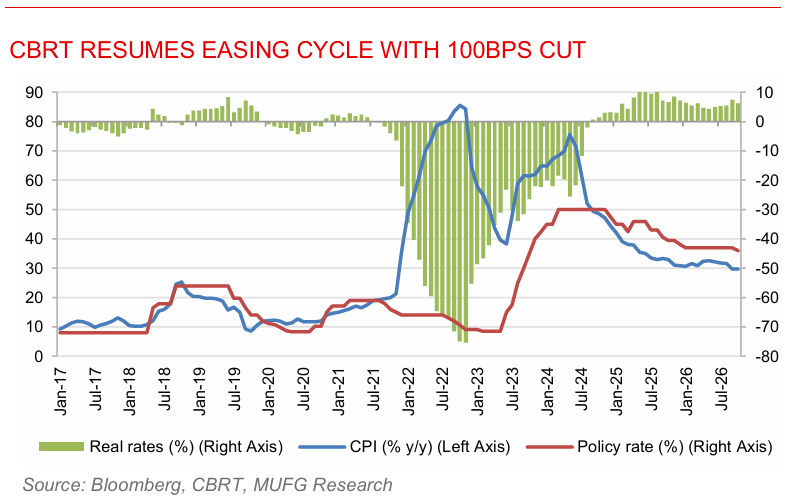
Turkey delivers first rate since January as inflation ease. Turkey’s central bank (CBRT) cut policy rates by 100bps to take the one-week repo rate to 36%. The move follows a better-than-expected inflation print for September (at 29.7% y/y), cooling growth and a resumption of repo auctions at the official policy rate several weeks ago. This was the first cut since January this year as the central bank held policy unchanged amid an uncertain global inflation environment caused by elevated energy prices and a changed outlook for Fed rates from the US. The bank noted that inflation may continue to ease thanks to waning domestic demand but also noted that future decisions will be “decided prudently on a meeting-by-meeting basis.” That suggests the bank will not necessarily adopt sequential path lower in rates but will opt for pauses to evaluate the inflation environment around each meeting in 2027.
MENA growth hit by prolonged conflict recovery expected in 2027. The IMF's October 2026 Regional Economic Outlook projects MENA GDP to contract by 2.0% in 2026 before rebounding by 7.0% in 2027, reflecting severe disruptions to hydrocarbon production, trade, logistics and tourism from the prolonged Middle East conflict. The downturn is concentrated in GCC economies, where GDP is forecast to shrink by 4.8% in 2026 before recovering by 9.1% in 2027, driven by the gradual restoration of energy production and exports. Kuwait (-16.7%), Qatar (-15.6%) and Bahrain (-11.3%) face particularly sharp contractions, while Saudi Arabia (-3.3%) and the UAE (-3.9%) are also expected to enter recession. In contrast, oil-importing economies have remained relatively resilient, supported by domestic demand, tourism, remittances and policy measures. Regional inflation is projected to rise to 14.9% in 2026 before easing to 11.0% in 2027, while fiscal and external buffers face increasing pressure. Risks remain firmly tilted to the downside, particularly from renewed geopolitical escalation, prolonged energy disruptions and tighter global financial conditions.