
To read the full report, please download the PDF above.
Middle East Daily
SOOJIN KIM
Research Analyst
DIFC Branch – Dubai
T: +44(4)387 5031
E: soojin.kim@ae.mufg.jp
MUFG Bank, Ltd. and MUFG Securities plc
A member of MUFG, a global financial group
Middle East Daily
COMMODITIES / ENERGY
Oil falls below USD 99/b as Saudi pipeline restart and Iran talks ease supply fears. Brent dropped below USD 99/b, while WTI traded near USD 90/b. Prices came under pressure as Saudi Arabia moved closer to restoring exports through its 7m b/d East-West pipeline, which would allow more crude to bypass the Strait of Hormuz following damage earlier this month. Diplomatic prospects also improved after President Trump described US contacts with Iranian representatives as “very productive,” with further meetings planned. However, significant risks remain as the US continues to blockade Iranian ports, Iran targets vessels in Hormuz, and Houthi attacks threaten Saudi energy infrastructure and shipping near Bab el-Mandeb. US inventory data were mixed, with the API reporting a 1.8mb crude build but declines in gasoline and distillate stocks. Progress on both Saudi export capacity and US-Iran diplomacy is unwinding part of the geopolitical premium, although unresolved Hormuz and Red Sea risks leave the market vulnerable to renewed disruption.
Gold edges lower as Iran talks and Fed outlook weigh. Gold edged lower to around USD 4,340/oz as investors weighed renewed US-Iran diplomacy against the prospect of further Fed tightening. President Trump described recent US-Iran talks as “very good,” raising hopes of a diplomatic resolution and lower energy-related inflation pressures. Meanwhile, Fed officials warned inflation could remain persistent and signalled rates may need to stay restrictive. While higher borrowing costs continue to weigh on non-yielding gold, strong physical demand, particularly from China, remains supportive. Further progress in US-Iran talks could weaken safe-haven demand, while the Fed’s inflation outlook remains the key driver for gold.
MIDDLE EAST - CREDIT TRADING
End of day comment – 22 September 2026. The market partially rebound its strength today. UST turned higher in the morning on more US/Iran diplomacy reports and Saudi planning to load oil in the red sea this week which gave cash a bid. Especially UAE long dated bonds were bid again and found only willing sellers approximately 0.5pt higher. ADGB 54s stood out closing +0.625pt/-5bp. Against this though belly bonds were pretty static in cash price terms widening 2bp in the morning and coming back to unch into the close with lower UST. New QATAR had a decent reception, 36s were active closing 98.25/98.50 (T+65/62) about -1bp from its reoffer spread. The 5y tranche was less active, and I have it 99.35/45 into the close which straddles its T+55 reoffer spread. In fins new SIB 5y priced at T+105bp for 500mm. Yields near 6% have attracted yield buyers in senior fins lately, but new deals continue to reprice outstanding bonds/curves, so despite some stabilisation today in fins I would expect more selling of older bonds around new issuance to continue. Overall risk sentiment has improved. (Source: Dominik Roth, Credit Trader)
MIDDLE EAST - MACRO / MARKETS
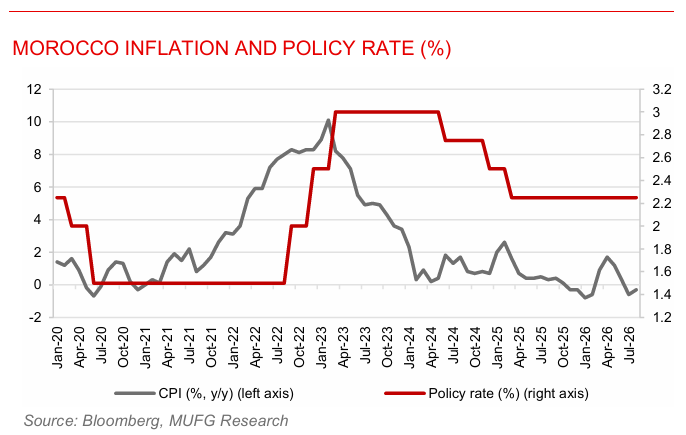
Morocco holds rates at 2.25% despite low inflation. Bank Al-Maghrib kept its benchmark rate unchanged at 2.25%, as expected, judging current policy appropriate amid moderate medium-term inflation and stabilising non-agricultural activity. Inflation has remained exceptionally subdued, averaging just 0.3% in the first eight months of 2026, while the central bank expects headline inflation of 0.7% this year and 1.5% in 2027. However, the regional conflict is creating external pressures, with Morocco’s energy import bill projected to rise 28.4% to around MAD138bn, contributing to a widening current-account deficit of 4.6% of GDP. Domestic inflationary pass-through should remain relatively contained as subsidies cushion public transport, cooking gas and electricity prices. Meanwhile, the central bank lowered its 2026 GDP growth forecast to 4.4%. With domestic inflation subdued but external financing pressures rising, further monetary easing will depend increasingly on energy prices, the current-account position and the resilience of Morocco’s foreign-exchange buffers.
Egypt builds strategic oil stockpile as regional supply risks rise. Egypt plans to build a 16mb strategic crude stockpile through new supply agreements with Libya and Iraq, strengthening refinery security amid heightened regional supply and shipping risks. The agreements cover 10mb from Libya and 6mb from Iraq at USD 85/b, valuing the crude at around USD 1.36bn before logistics costs. Egypt has already received 3mb, with the remainder expected by end-2026. The move comes as declining domestic energy production increases reliance on imports. Gas output fell to a multi-decade low of 3.65bcf/d in July, while LNG imports more than doubled y/y to 9.36mn tonnes in January-August. Egypt is simultaneously seeking to reverse the decline through new exploration tenders and a USD 1.6bn upstream investment programme with foreign producers. The strategic stockpile should provide a near-term buffer for Egypt’s refining system, but sustained energy security will depend on stabilising domestic production and limiting further growth in costly fuel imports.