
To read the full report, please download the PDF above.
Middle East Daily
SOOJIN KIM
Research Analyst
DIFC Branch – Dubai
T: +44(4)387 5031
E: soojin.kim@ae.mufg.jp
MUFG Bank, Ltd. and MUFG Securities plc
A member of MUFG, a global financial group
Middle East Daily
COMMODITIES / ENERGY
Oil retreats as US-Iran talks raise prospect of Hormuz reopening. Oil fell as US and Iranian negotiators explored a potential phased agreement to reopen the Strait of Hormuz, with Brent retreating toward USD 105/b and WTI falling below USD 93/b. Iran has reportedly submitted a seven-day proposal to the US under which it would reopen the waterway if certain conditions are met, although previous diplomatic efforts have failed to produce a lasting agreement. Supply risks remain significant, with Saudi Arabia intercepting further Houthi missile attacks and its critical East-West pipeline remaining offline, while France and the UK have committed additional defensive support to the kingdom. Physical crude markets also remain exceptionally tight, reflected in record premiums for prompt barrels at Cushing and a wide Dated Brent premium over futures. A credible agreement to reopen Hormuz could materially reduce the geopolitical premium, but continued regional attacks, tight physical supply and uncertainty over negotiations should keep crude prices highly volatile.
Gold heads for weekly loss as higher yields weigh. Gold edged higher to around USD 4,300/oz but remained on track for a roughly 2% weekly decline, as elevated energy prices and persistent inflation concerns reinforced expectations for further Fed tightening. The recent energy-price spike has intensified inflation concerns and pushed US Treasury yields sharply higher, with the 30-year yield approaching 5.5%, its highest in more than two decades. Gold has consequently remained confined to a relatively narrow range around USD 4,300/oz during September as markets repeatedly reassess the Fed’s policy path. While geopolitical uncertainty and demand for portfolio hedges continue to provide underlying support, persistently high Treasury yields and expectations of additional rate hikes remain the key near-term headwinds for gold.
MIDDLE EAST - CREDIT TRADING
End of day comment – 24 September 2026. Very weak day. Like mentioned yday the tighter close yday was only due to the selloff in UST into London close, today we saw the retracement and a bit more. The bid in long end bonds is taking a step back, seen selling throughout the day in ADGB 54s closing -1pt/+4bp. Belly bonds equally were up to -0.5pt lower and +4/5bp. New QATAR 5y and 10y both widened 4/5bp today, 36s (-0.875pt/+5bp) was again the more active of both. Fin bonds were generally weak led by T2 and AT1 across names (-0.25pt/-0.5pt) but there were pockets of demand in senior bonds, especially FABUH found buyers of new 5.456 31s (-0.25pt/-3bp) and shorter end bonds like 29s conv and sukuk. Quasi sovgn were very weak. Especially MUBAUH belly bonds saw aggressive dealer selling pushing 5/10y bonds up to 0.75pt lower/+5/8bp. With further macro risk weakness seen today it feels like the path of least resistance is wider. ETFs are also becoming more active and sizeable sellers. After yday 5y auction market will look more closely on the 7y today, meanwhile oil is moving higher and risk is off. Primary markets should be quiet in such an environment. (Source: Dominik Roth, Credit Trader)
MIDDLE EAST - MACRO / MARKETS
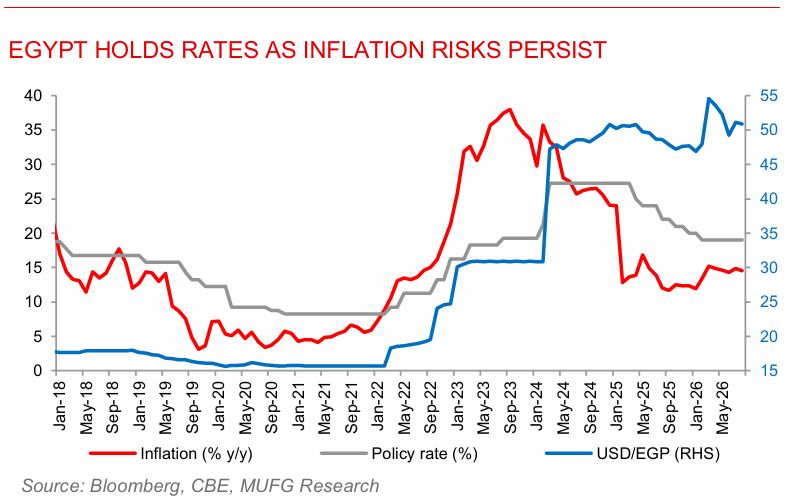
Egypt holds rates as regional risks loud inflation outlook. Central Bank of Egypt (CBE) kept interest rates unchanged for a fifth consecutive meeting, holding the deposit rate at 19% and lending rate at 20%, as renewed regional hostilities threaten higher energy costs and inflation. Inflation has nevertheless remained relatively contained, allowing the CBE to revise its forecast lower and project a gradual convergence toward its 7% ±2ppt target in H2 2027. The central bank said its current stance remains sufficiently restrictive to support disinflation but warned that risks are tilted upward due to the resurgence in regional tensions. External buffers have also proved resilient. Foreign holdings of Egyptian local debt fell from USD 39.1bn in February to USD 22.2bn in early April before recovering toward pre-conflict levels, while reserves stood at USD 57.2bn in August. With the pound recovering and inflation easing, domestic conditions could support renewed easing, but elevated energy prices and regional uncertainty are likely to keep the CBE cautious in the near term.
Saudi crude exports rebound as Hormuz flows resume. Saudi crude exports rose to 5.28mb/d in September, the highest since February, as the kingdom rapidly shifted shipments back through the Strait of Hormuz following an attack on its East-West pipeline. Saudi Arabia had largely avoided Gulf exports earlier in the conflict, relying instead on the 7mb/d East-West pipeline and Red Sea terminals, but flows through the pipeline halted for almost two weeks after a drone strike damaged a pumping station. Since mid-September, Aramco has sold nearly 100mb for October-November delivery through Hormuz to Asian buyers, alleviating regional supply tightness. Meanwhile, repairs have allowed East-West pipeline flows and Yanbu loadings to begin resuming, which should also support shipments via Egypt’s Sidi Kerir terminal. The recovery across both Hormuz and Red Sea routes should improve Saudi export capacity and ease some physical-market tightness, although shipping security remains a key risk.