
To read the full report, please download the PDF above.
Middle East Daily
EDWARD BELL
Head of Research
DIFC Branch – Dubai
T: +971 (4)387 5033
E: edward.bell@ae.mufg.jp
SOOJIN KIM
Research Analyst
DIFC Branch – Dubai
T: +971 (4)387 5031
E: soojin.kim@ae.mufg.jp
MUFG Bank, Ltd. and MUFG Securities plc
A member of MUFG, a global financial group
Middle East Daily
COMMODITIES / ENERGY
Oil rises as Middle East tensions reinforce geopolitical risk premium. Oil prices are trading higher after a choppy session overnight. Brent futures are up around 2% near USD 116/b while WTI has added around the same amount to trade near USD 101.88/b. Markets have geopolitical dynamics in the Middle East squarely in focus with reports that the US and Israel are preparing a new offensive against Iran to take place after the US midterms while the outcome of the Israeli legislative election still remains unclear. Saudi Aramco also said that it had contained at fire close to the Ras Tanura oil export terminal after an attack while further missile attacks against the oil producing eastern region of Saudi Arabia were reported overnight. Elsewhere in fundamentals, the API reported a draw of 2m bbl in crude inventories last week while gasoline and distillate stockpiles both increased.
Gold steadies around USD 4,040 ahead of key Fed decision. Gold prices edged higher overnight but are drifting lower in early trade today at around USD 4,041/oz. Markets are watching the outcome of the FOMC later today with no expectation of a hike from the Fed but focus on whether commentary shifts to a more hawkish stance and if there is any clarity on where rates head in 2027. Later this week the release of the PCE inflation index will affirm whether the Fed is odds in for a December hike or if rate hike expectations for the December meeting fade further. Markets are currently pricing in around 23bps of hikes for the December FOMC.
MIDDLE EAST - CREDIT TRADING
End of day comment – 27 October 2026. Strong close. The morning was a bit more of the same. We saw sovgn curves stabilising but the market still seller in non sovgn bonds, especially financials where the market remains reluctant to put bids against. Later morning a bit of headline ping pong started around Iran, the headlines kept on coming well into the close with some Russia/ Ukraine related joining. That clearly lifted risk sentiment and we saw some short covering in benchmarks. With macro risk further strengthening in the US session we finally saw flows turning and the market quickly became risk on. The bid was led by long bonds, ADGB 54s closed +0.375pt/-4bp. QATAR 36s quickly saw short covering as well going out +0.25pt/-4bp. The KSA complex was -2/4bp also led by long end, KSA 54s closed +0.375pt/-4bp. The outperformer in the sovgn space was OMAN though, a few buyers of long end bonds brought short covering out here as well with 51s squeezing most closing +0.875pt/-8bp. It was less of a rush in quasi sovgn (-2/3bp) and financials, but we saw the first bonds recovering a bit from the lows, new DHBKQD 31s closed +0.125pt/-3bp. Overall a much better feel to risk into the close albeit the moves are mostly driven by short covering, whilst we have seen flows turning a bit more +ve in the last 2 hours the market is still lacking broad based buying interest from RM. (Source: Dominik Roth, Credit Trader)
MIDDLE EAST - MACRO / MARKETS
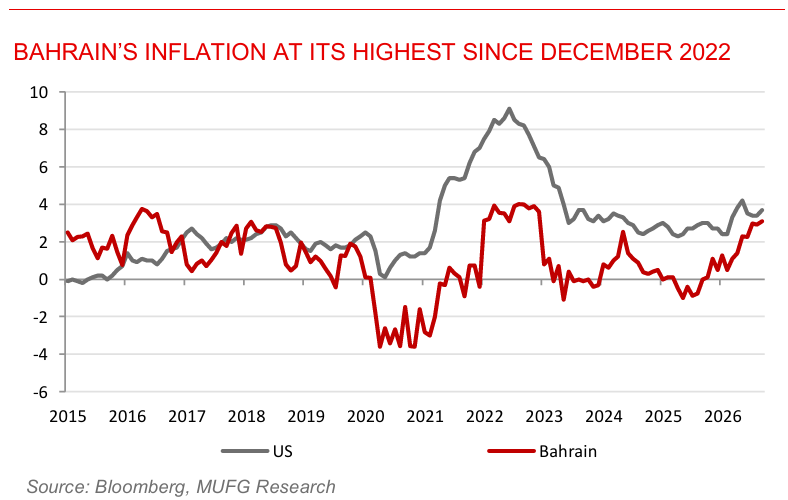
Bahrain’s inflation rises to 3.1% in September. Bahrain’s annual inflation increased to 3.1% y/y in September 2026 from 3.0% y/y in August, reaching its highest level since December 2022 amid rising transport and food costs. Consumer prices rose 0.7% m/m, accelerating from 0.2% in August, reflecting renewed price pressures across several expenditure categories. Transport inflation surged to 11.6% y/y from 7.8%, emerging as the primary driver of the increase, while food and non-alcoholic beverage inflation remained elevated at 8.0%. Price pressures also strengthened in household furnishings and communications, although recreation and culture inflation moderated sharply to 2.9% from 10.1%. Meanwhile, housing and utilities prices declined 1.3% y/y, while clothing and footwear fell 9.1%, helping contain headline inflation. Bahrain’s inflation now exceeds Saudi Arabia’s 1.9% and approaches Oman’s 3.2%. Persistent transport and food price pressures could keep inflation elevated through Q4, although declining housing costs and easing inflation in selected categories may help limit further increases.