
Saudi Arabia recorded a deficit of SAR 244bn in the first nine months of 2026, exceeding its original 2026 budget plan
Oil income is due to increase in Q4 thanks to higher prices and efforts to maximize production but the outlook is contingent on geopolitical stability.
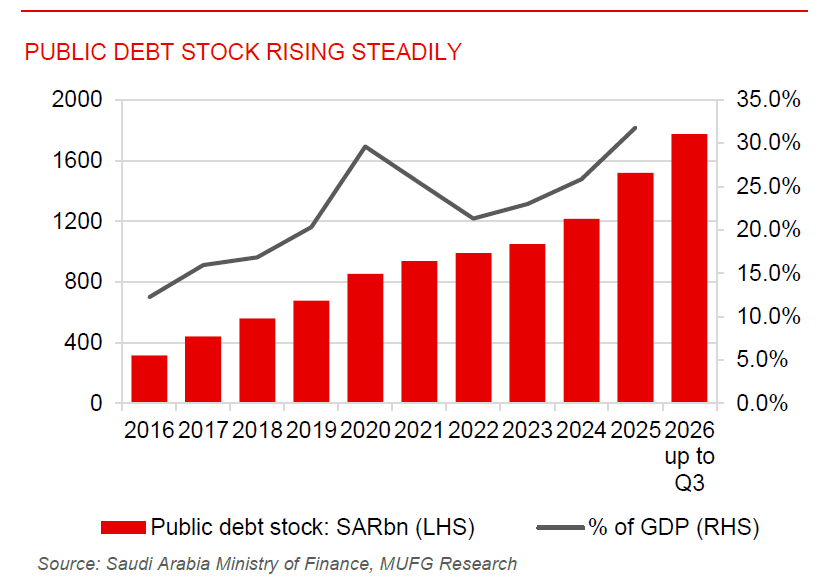
Public debt continues to increase in Saudi Arabia though relative to peer economies it remains low as a share of GDP.
Saudi Arabia's deficit in first nine months exceeds 2026 annual plan
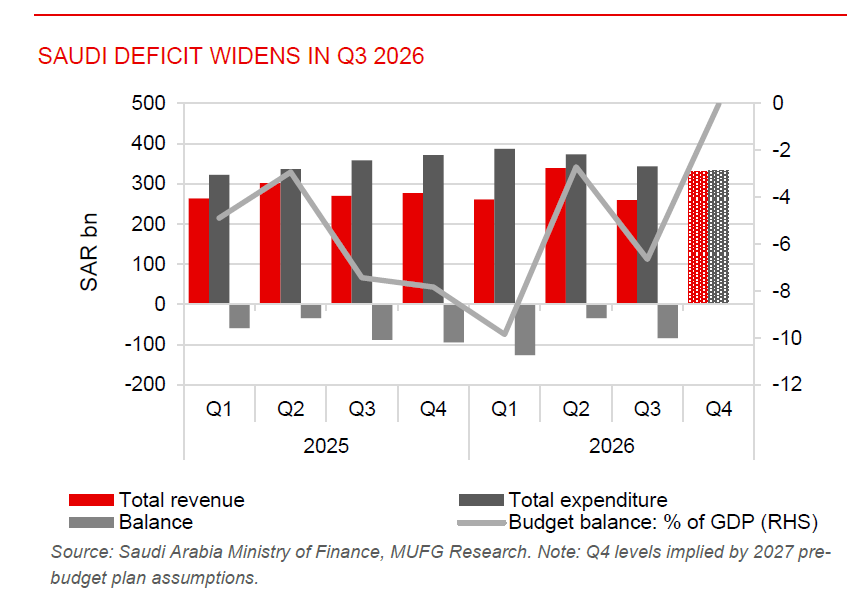
Saudi Arabia’s Ministry of Finance reported a budget deficit of SAR 84.3bn (USD 22.5bn) in Q3 2026, bringing the year-to-date deficit to SAR 244bn. The deficit for the first nine months of the year is well ahead of the original SAR 165bn deficit planned in the 2026 budget and close to the revised estimate of SAR 244bn for the whole of 2026 released in the 2027 pre-budget plan.
Q3 revenue impacted by lower oil prices
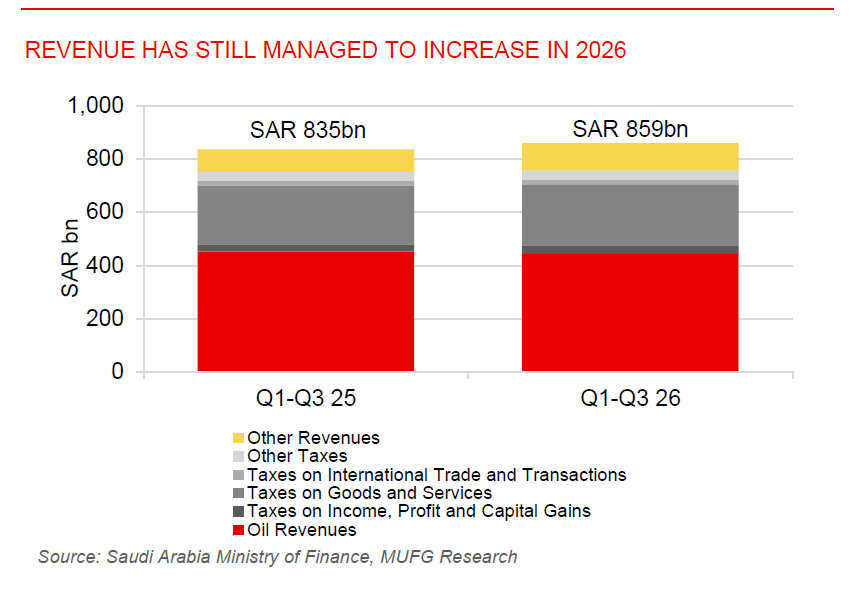
Total revenue dropped by 4% y/y in Q3 to SAR 259bn thanks to a sharp decline in oil revenue, down 23% y/y to SAR 116bn. The third quarter coincided with a period of relatively lower oil prices this year as export volumes from the Middle East increased during the brief window when the US-Iran Memorandum of Understanding was in effect while export volumes from Saudi Arabia specifically were also negatively impacted in Q3 when the Houthi militants in Yemen began to step up attacks against Saudi Arabia and the critical East – West pipeline was temporarily knocked out of operation in September. Non-oil income rose by nearly 20% y/y, however, as the Saudi economy showed signs of adaptation to the conflict. The non-oil sector reported growth of 2% y/y in Q3, helping to support annual gains in tax income.
On the expenditure side, total spending dropped by 4.2% in Q3 with declines in the government wage bill, consumption and capex. However, financing costs showed a sharp increase, up 69% y/y thanks to a rising public debt stock in Saudi Arabia. For the first nine-months of the year, total expenditure rose 8.5% with stronger gains in capex spending in the first half of the year.
Balance of year revenue outlook contingent on geopolitics
Based on the pre-budget plan for 2027, the fiscal deficit would be due for a substantial narrowing in Q4 to essentially balanced assuming that implied revenue targets of SAR 331bn for the quarter can be achieved. Oil prices have increased substantially so far in Q4 2026 on geopolitical anxiety of a renewed conflict in the Middle East: since the start of October 2026, Brent futures have recorded an average of nearly USD 108/b compared with a Q3 average of USD 91.30/b. Saudi Aramco has also indicated it plans to maximize production in the final months of the year which could materially improve revenue generation in the final quarter. However, the outlook for oil income—which still represented 52% of total fiscal income in the first three quarters of 2026—is highly contingent on a stable geopolitical situation in the Middle East. Non-oil income will depend on the outlook for the rest of the economy with PMI levels for October still reporting solid expansion.
Public debt stock is moving higher, with greater claim on overall expenditure
Assuming the Ministry of Finance is able to hit its revenue and expenditure targets in Q4 then the need to increase borrowing in the final months of the year will be limited. Saudi Arabia has met its fiscal short fall in 2026 by borrowing, increasing the stock of external debt to SAR 638bn (USD 170bn) as of the end of Q3 2026 while making heavier use of domestic currency borrowing to meet financing needs. The Ministry of Finance estimates total public debt at SAR 1,773bn (USD 473bn) as of Q3 2026, an increase of nearly 17% since the start of the year. Relative to G20 peer economies, Saudi Arabia’s debt to GDP level at 32% as of end 2025 is low but the increase in the last 10 years has been notable. Debt servicing costs as a share of total government spending has increased from levels of less than 2% in 2018-19 to 5% as of the first nine months of 2026.
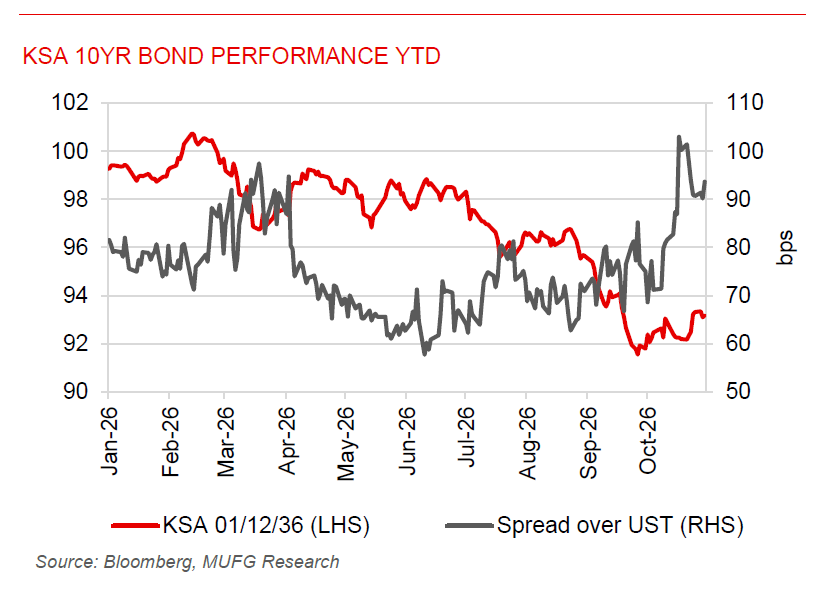
Saudi Arabia has tapped external markets twice in 2026, raising USD 11.5bn in January in a four-tranche issue with maturities spread over 3YR, 5YR, 10YR and 30YR and a dual tranche USD sukuk in September, raising USD 3.25bn across 5YR and 10YR maturities. The Ministry of Finance is due to release its borrowing plan for 2027 by the end of this year, likely trying to find a mix of lenders including public bond markets as well as borrowing from private placements and export credit agencies. Based on the performance of the last several years, Saudi Arabia is likely to be one of the first major economies off the block to tap markets in the new year.