
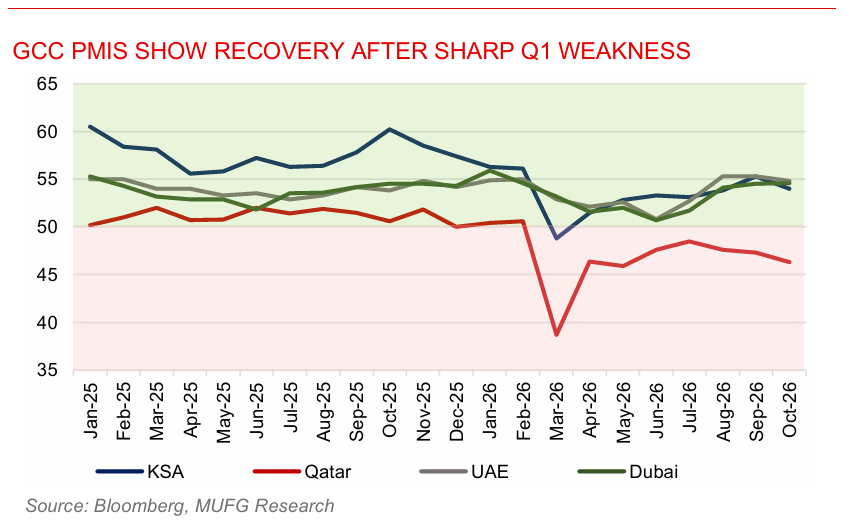
Non-oil growth is broad but levelled off in October. Saudi Arabia (54.0), the UAE (54.8) and Dubai (54.6) are all in expansion, with Qatar (46.3) the outlier. Hiring and export orders lag output, and costs are rising with record UAE selling prices and Saudi input costs at a four-month high.
October PMIs show broad but plateauing non-oil growth, with hiring and export orders lagging output
Most regional PMI readings remain in expansion, showing signs of adaptation in the local economies to the impact of the regional conflict. PMI levels in Saudi Arabia at 54.0, the UAE at 54.8 and Dubai at 54.6 all remain substantially above the neutral 50 level though for Saudi and the UAE, the October print eased from recent highs hit in September. Qatar's non-energy PMI for October sat at 46.3, holding in contraction since March and declining from a month earlier. Activity in Saudi Arabia continues to be supported by domestic activity while in the UAE new export orders rose by the strongest pace in the last two years according to S&P. UAE employment slipped for the third time in five months, Dubai firms made modest cuts and Qatar's fell for the first time since July 2024, while Saudi employment has continued to rise. UAE confidence is the highest since January and backlogs are building. Cost pressures are also rising, with UAE selling prices up at a record pace and Saudi input costs at a four-month high, though output price inflation eased to a nine-month low, tracking the soft levels in headline CPI.
Signals from the non-oil economy suggest recovery in activity in H2
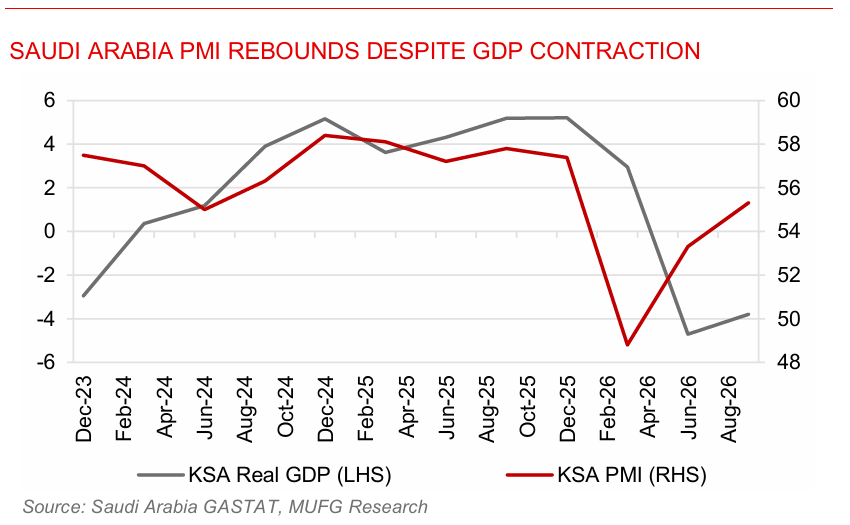
The PMI numbers suggest that after a sharp downturn in activity in H1, the non-oil sectors in Saudi Arabia and the UAE are showing signs of recovery. Saudi Arabia’s GDP fell 3.8% in Q3, largely down to a 20.4% decline in oil activity while non-oil growth improved to +1.9% y/y. UAE growth was 0.4% in H1 after a 2.1% fall in Q2 with the non-oil sector contracting by 1.1%. Activity in Qatar remains subdued with the economy contracting by nearly 16% y/y in Q2 thanks to a sharp drop in the energy sector though the non-energy sector managed growth of 2.6% y/y.
Non-oil trade is also holding up despite the conflict’s impact on regional shipping. Saudi non-oil exports rose 8.5% in August and UAE H1 non-oil trade was up 13.1% to a record AED 1.94trn. Domestic demand and credit are also resilient, with Saudi weekly point of sale spending above USD 3bn, Saudi bank Q3 profits up 5.3% and UAE banks guiding to loan growth in the low 20s%, though funding costs are rising. Tourism and property are the weak spots. Dubai's overnight visitors fell 44% in January to August, its transport and storage output fell 7.4% in Q2 and Saudi land transactions fell 55% in Q1.